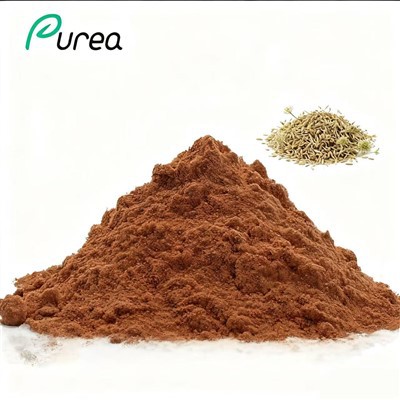


Chasteberry Extract Powder is a botanical ingredient derived from the fruit of Vitex agnus-castus L., also known as chaste tree or Vitex. It is supplied as a dry extract with defined extraction ratios and selected marker specifications for use in botanical and women's health supplement formulations.
Product Specifications
|
Specification |
Details |
|
Product Name |
Chasteberry Extract Powder |
|
Botanical Name |
Vitex agnus-castus L. |
|
Common Names |
Chasteberry, Chaste Tree, Vitex |
|
Plant Part |
Fruit |
|
Product Form |
Fine Powder |
|
Appearance |
Brown-red to brown fine powder |
|
Extract Ratio |
4:1–20:1 |
|
Available Standardizations |
5% Vitexin; 5% Flavones |
|
Particle Size |
80 mesh; other sizes available upon request |
|
Shelf Life |
24 months under recommended storage conditions |
|
Certifications |
ISO, Kosher, Halal |
|
Storage |
Tightly sealed in a cool, dry place away from direct sunlight |
Botanical Standardization Considerations
Chasteberry extract specifications can be based on extraction ratio or defined marker levels, which provide different types of technical information.
Extraction Ratio: A 4:1–20:1 ratio describes the concentration relationship between the original fruit material and the resulting extract.
Marker Specification: Vitexin and flavones can be used as measurable parameters for selected Chasteberry grades.
Analytical Method: Marker values should be reviewed together with the analytical method used to determine them, especially when comparing materials from different suppliers.
Specification Basis: The selected specification should correspond with the intended formula, inclusion level, dosage format, and target-market requirements.
When qualifying the raw material, extraction ratio, marker level, analytical method, and physical specifications should be reviewed together.
Formulation Considerations
Powder Blending: Particle size and powder characteristics should be considered when Chasteberry is combined with multiple dry ingredients to support uniform blending.
Capsules & Tablets: The extract can be incorporated into solid dosage formulas with botanical, vitamin, mineral, or other functional ingredients according to the required inclusion level.
Multi-Botanical Formulas: Marker specifications and inclusion rates should be evaluated alongside the characteristics of other botanical extracts to maintain a clearly defined formula.
Powdered Beverages: Dispersion, particle size, sensory characteristics, and compatibility with the complete powder system should be assessed for dry beverage applications.
Selecting the Right Chasteberry Specification
|
Requirement |
What to Review |
Why It Matters |
|
Extract concentration |
Extraction ratio |
Defines the concentration relationship between the original fruit material and finished extract |
|
Defined composition |
Marker and assay level |
Provides a measurable reference for the selected grade |
|
Analytical comparability |
Test method and specification basis |
Helps distinguish specifications using different analytical approaches |
|
Processing compatibility |
Particle size and powder characteristics |
Supports evaluation against blending, filling, and handling requirements |
|
Formula suitability |
Inclusion level and dosage format |
Helps determine whether the selected grade fits the intended finished product |
|
Market requirements |
Applicable standards and specifications |
Allows the raw material to be assessed against destination-market requirements |
Botanical Quality Control
Botanical Identity
The material is derived from Vitex agnus-castus L. fruit, providing a defined botanical source and plant part for raw-material qualification.
Composition Verification
Vitexin or flavone specifications can be used as measurable parameters for the applicable Chasteberry grade.
Physical & Chemical Parameters
Appearance, particle size, moisture, and ash can be evaluated for the dry extract.
Contaminant Control
Heavy metals such as lead, arsenic, cadmium, and mercury can be included in the quality specification according to applicable requirements.
Microbiological Control
Relevant testing can include total plate count, yeast and mold, E. coli, and Salmonella.
Certification
ISO, Kosher, and Halal certifications are available for the supplied specification and should be confirmed for the specific commercial grade.
The agreed specification and analytical methods should be established before raw-material qualification.
Raw Material Handling & Storage
Moisture & Sealing: Keep the material tightly sealed and minimize exposure to humid conditions during opening, weighing, blending, and repacking.
Temperature & Light: Store in a cool, dry environment away from direct sunlight and prolonged heat exposure.
The stated shelf life is 24 months under the recommended storage conditions.
Frequently Asked Questions
Q: What is the difference between Chasteberry extract ratio and marker standardization?
A: An extract ratio describes the relationship between the starting botanical material and the resulting extract. A marker specification defines the measured level of a selected compound or compound group. They provide different types of technical information and should not be treated as equivalent specifications.
Q: Which markers can be used for Chasteberry Extract?
A: Vitexin and flavones can be used as specifications for selected Chasteberry grades. Other markers, such as agnuside, may also be used for botanical characterization depending on the product specification and analytical method.
Q: Can different Chasteberry extract specifications be used interchangeably?
A: Not necessarily. Extract ratio, marker level, analytical method, and inclusion rate can differ between grades, so changing specifications may affect the raw-material profile and finished-product formula. Any substitution should be evaluated against the approved product specification.
Q: What should buyers check when comparing Chasteberry Extract suppliers?
A: Key points include botanical identity, plant part, extraction ratio, marker specification, analytical method, particle size, moisture, ash, heavy metals, microbiological limits, certifications, and storage requirements.
Q: What particle size is available for Chasteberry Extract Powder?
A: The supplied specification uses 80 mesh as the standard particle size. Other particle sizes can be considered when required by the buyer's blending, filling, or processing system.
Q: Can Chasteberry Extract be used in multi-botanical formulas?
A: Yes. It can be incorporated into multi-botanical formulations when the selected grade is compatible with the other ingredients in terms of inclusion level, particle characteristics, marker specifications, and processing requirements.
Q: How should Chasteberry Extract Powder be stored?
A: The powder should remain tightly sealed in a cool, dry environment and be protected from direct sunlight and excessive humidity. The stated shelf life is 24 months under the recommended storage conditions.
Hot Tags: chasteberry extract powder, China chasteberry extract powder manufacturers, suppliers, factory, Arnica Montana Flower Extract Powder, Saw Palmetto Oil Extract Powder, Gromwell Root Extract Powder, Glehnia Root Extract Powder, Organic Pandan Leaf Powder, natural animal plant extracts